
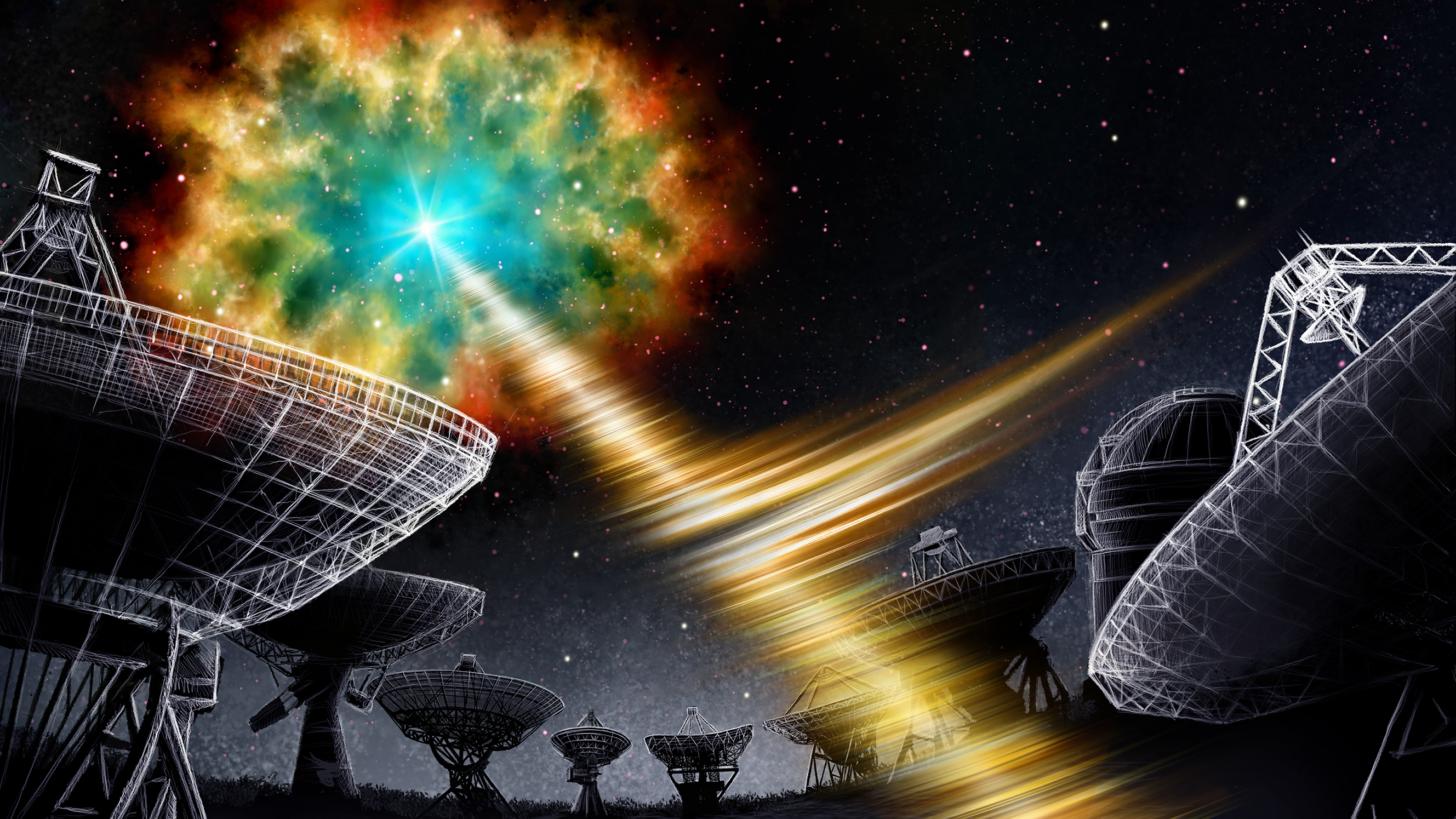
Artist’s impression of Fast Radio Bursts emitted by a distant source (copyright: Daniëlle Futselaar/ASTRON)
A team led by astronomers in the Netherlands has achieved an exceptionally precise localisation of a repeating fast radio burst (FRB), confirming that it originates from the heart of a persistent source of radio emission.
These results were obtained using the European VLBI Network (EVN), a collection of radio telescopes spread across Europe and beyond that operate together as a single, Earth-sized instrument.
The signals from these antennas were combined at JIVE, allowing astronomers to pinpoint the positions of cosmic radio sources with extraordinary precision — equivalent to spotting a handbag on the Eiffel Tower while looking from New York City.
Fast radio bursts are brief but powerful flashes of radio waves from galaxies other than our own. Although thousands of FRBs have now been detected, their physical origin remains a mystery. While most FRBs are only seen once, a small fraction repeat, allowing astronomers to study them in greater detail.
Zooming in on an extreme environment
FRB 20190417A is a repeating FRB discovered in 2019 by the CHIME/FRB Collaboration. Its unusual properties suggest that it resides in a dense and highly magnetised environment. Previous observations had identified a source of radio emission near the FRB's position, but the association could not be confirmed at the highest angular resolutions.
“With the EVN, we were able to pinpoint FRB 20190417A with milliarcsecond precision and directly compare its position to that of the constantly shining source of radio waves”, says Alexandra Moroianu, lead author of the study and PhD researcher at the Anton Pannekoek Institute for Astronomy and the Joint Institute for VLBI ERIC (JIVE). “We found that the bursts and the steady radio source are spatially coincident, confirming that they are physically connected.”
A compact and energetic, constantly shining radio source
The EVN observations show that the steady radio source is compact, with a size constrained to less than 80 light years, comparable to the size of a supernova remnant.
Although FRBs last just milliseconds, sources of persistent radio emission can remain active for years. Despite the large number of FRBs discovered to date, only a handful have been traced back to these radio sources. With this new result, FRB 20190417A becomes the fourth well-established system in which a repeating FRB is directly associated with a persistent radio source.
“With this new system, a pattern is starting to emerge”, says Moroianu. “These particular FRB sources appear to live in extreme magneto-ionic environments, often in small, chemically primitive galaxies that are actively forming stars.”
A step toward understanding fast radio bursts
One leading explanation for repeating FRBs involves magnetars: ultra-magnetised neutron stars formed in supernova explosions. In these models, the steady radio emission may trace a nebula powered by the young compact object.
“Thanks to these observations, we know that if these persistent radio sources are powered by magnetars, they must be really young in astronomical terms - less than a thousand years old”, says Benito Marcote, Senior Support Scientist at JIVE and ASTRON.
Other interpretations include hypernebulae - highly magnetised plasma powered by a compact object feeding on material from a massive star - and a magnetar embedded in the environment of a black hole. Distinguishing between these scenarios will require further observations of similar systems.
By pinpointing the location of FRB 20190417A and confirming its association with a compact, steady source of radio waves, this study demonstrates the power of precise radio imaging in uncovering the environments of FRBs and interpreting their origins. As more FRBs are pinpointed, astronomers hope to determine whether steady radio sources are a short-lived phase common to many FRBs, or instead the defining feature of a distinct sub-population.
The team has published their results in The Astrophysical Journal Letters under the title:
“A Milliarcsecond Localization Associates FRB 20190417A with a Compact Persistent Radio Source and an Extreme Magnetoionic Environment”.
Link to the paper: 10.3847/2041-8213/ae28c7
JIVE contacts
Benito Marcote, JIVE Support Scientist: marcote@jive.eu
Ioanna Kazakou, JIVE Communications Officer: kazakou@jive.eu
About JIVE and the EVN
The Joint Institute for VLBI ERIC (JIVE) has as its primary mission to operate and develop the European VLBI Network data processor, a powerful supercomputer that combines the signals from radio telescopes located across the planet. Founded in 1993, JIVE is since 2015 a European Research Infrastructure Consortium (ERIC) with seven member countries: France, Italy, Latvia, the Netherlands, United Kingdom, Spain and Sweden; additional support is received from partner institutes in China, Germany and South Africa. JIVE is hosted at the offices of the Netherlands Institute for Radio Astronomy (ASTRON) in the Netherlands.
The European VLBI Network (EVN) is an interferometric array of radio telescopes spread throughout Europe, Asia, and South Africa that conducts unique, high-resolution, radio astronomical observations of cosmic radio sources. Established in 1980, the EVN has grown into the most sensitive VLBI array in the world, including over 20 individual telescopes, among them some of the world's largest and most sensitive radio telescopes. The EVN is composed of 13 Full Member Institutes and 5 Associated Member Institutes.